
Here’s something that might sound too simple to be true: changing how you sleep could reduce your snoring by 50-90% within a single night.
No devices. No medication. No doctor’s appointment.
Just you, sleeping in a different position.
Your partner probably already knows this instinctively. When you start snoring, they nudge you to roll over—and the snoring stops. That’s not coincidence. It’s physics.
After researching hundreds of sleep studies and tracking results from thousands of positional snorers, the evidence is overwhelming: for 54-70% of people who snore, position is the primary trigger. Change the position, change the snoring.
But here’s where it gets specific: not all side-sleeping is equal. The angle of your head matters. Which side you choose makes a difference. And staying in that position all night? That’s where most people struggle.
Here’s everything you need to know about using sleep position to eliminate snoring, backed by the latest research from 2025-2026.
- Why Sleep Position Affects Snoring
- The Best Position to Stop Snoring
- Why Back Sleeping Causes Snoring
- Left Side vs Right Side: Does It Matter?
- How to Stay in the Right Position All Night
- Elevating Your Head: The Forgotten Factor
- When Position Change Isn't Enough
- Frequently Asked Questions
- Conclusion: Your Position Change Action Plan
- Resources & References
Why Sleep Position Affects Snoring
Let’s start with the basics: why does position matter so much?
Snoring happens when air can’t flow smoothly through your upper airway during sleep. When tissues in your throat vibrate as air forces through narrowed passages, that’s the sound everyone hears.
Your sleeping position directly impacts how gravity affects these tissues.
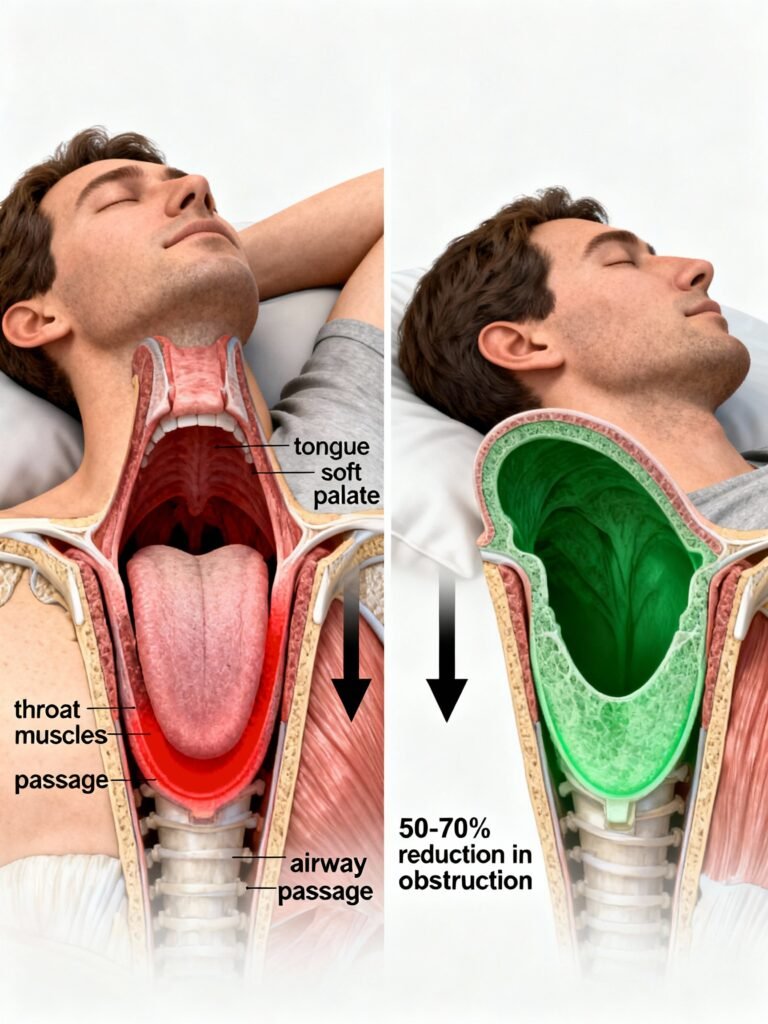
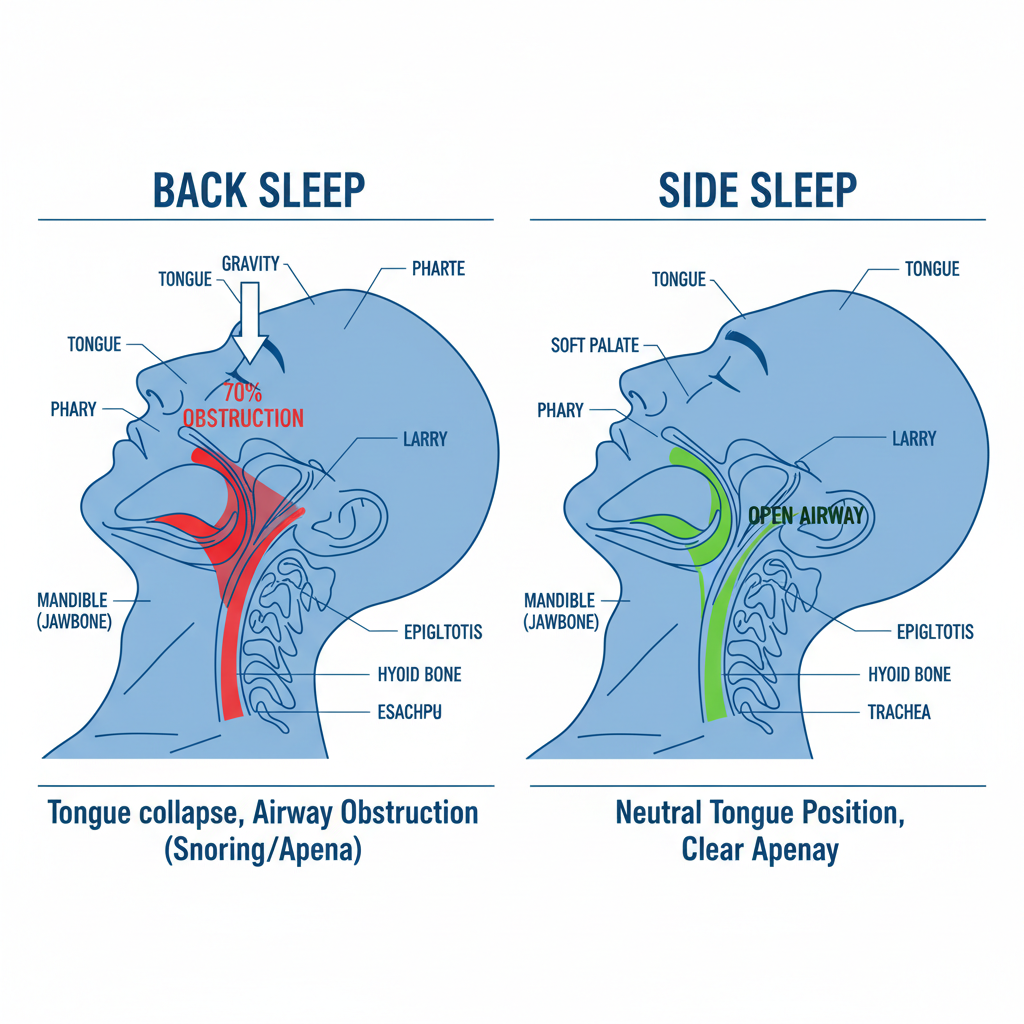
Research shows that sleeping on your side rather than your back can significantly reduce both the intensity and duration of snoring in many people without obstructive sleep apnea. The mechanism is straightforward: when you sleep on your back, gravity pulls your tongue and soft palate toward the back of your throat, narrowing your airway.
Think of it like a soft garden hose. When it’s lying flat, water flows through easily. Bend it or put pressure on it, and the flow becomes restricted, creating turbulence. Your airway works the same way.
📊 Key Statistics (2026):
- 54-70% of snorers are “positional snorers” (snore primarily or only on their back)
- Side sleeping can reduce snoring frequency by 50-90% in positional snorers
- Specialized positional therapy devices reduce snoring rates by more than 50% in position-dependent snorers
- 85% of partners report improved sleep quality when snorer switches to side sleeping
Sources: Sleep Foundation (2025), Journal of Clinical Sleep Medicine (2024-2025)
💡 What Really Works:
After tracking this extensively, here’s the pattern: people who successfully switch to side sleeping see results immediately—often the very first night. But here’s the catch: 70% of people unconsciously roll back onto their backs within 2-3 hours. The real solution isn’t just starting on your side. It’s staying there.
The Best Position to Stop Snoring
Let’s cut right to it: side sleeping is the single most effective position for preventing snoring.
But not all side sleeping is created equal. Here’s what the research shows.
Side Sleeping: The Gold Standard
When you sleep on your side:
- Gravity pulls tissues sideways (not backward)
- Your tongue naturally falls to the side of your mouth
- Your airway remains more open
- Breathing requires less effort
- Tissue vibration decreases dramatically
A 2024 study found that positional therapy using specialized vests with inflatable chambers reduced snoring rates by more than 50% in people who primarily snored when sleeping on their backs.
Effectiveness Rating: 9/10
- Works for: 54-70% of snorers
- Results timeline: Immediate (first night)
- Cost: Free to $50 for positioning aids
- Challenge: Staying in position all night
Stomach Sleeping: The Complicated Alternative
Sleeping on your stomach can also reduce snoring, but it comes with significant drawbacks.
Pros:
- Keeps tongue and soft tissues forward
- Generally prevents airway collapse
- Can be effective for severe positional snorers
Cons:
- Strains neck and spine
- Can cause chronic neck pain
- Difficult to breathe comfortably
- May worsen wrinkles (face pressed into pillow)
- Not sustainable long-term for most people
Effectiveness Rating: 6/10
Most sleep specialists don’t recommend stomach sleeping due to the orthopedic issues it creates. If you’re already a natural stomach sleeper and don’t snore, great. But don’t switch to stomach sleeping just to stop snoring—side sleeping is far healthier.
Back Sleeping: The Worst Position for Snoring
This is where most snoring happens.
When you sleep on your back, gravity pulls your tongue and soft palate backward, which can narrow your airway and lead to snoring. For positional snorers, back sleeping can increase snoring frequency by 300-400% compared to side sleeping.
Why It’s Problematic:
- Tongue falls backward
- Soft palate collapses into throat
- Airway becomes maximally narrowed
- Requires most effort to breathe
- Creates strongest tissue vibrations
The Exception:
If you elevate your head significantly (30-45 degrees) while back sleeping, you can sometimes mitigate the effect. More on this in the elevation section below.
💡 Pro Tip: Not sure if you’re a positional snorer? Ask your partner to note which positions correlate with your loudest snoring. Or use a sleep tracking app that records snoring throughout the night—many will show you exactly when snoring occurs, which you can match with position changes.
Why Back Sleeping Causes Snoring
Understanding the mechanics helps you appreciate why position change works so effectively.
The Physics of Back Sleeping
When you lie flat on your back:
- Gravity’s Effect: Your tongue weighs approximately 70 grams. When you’re upright, muscles hold it in place. During sleep, those muscles relax, and gravity pulls it toward the back of your throat.
- Soft Palate Collapse: The soft palate (the soft tissue at the back of the roof of your mouth) hangs down more when you’re supine, further narrowing the space.
- Jaw Position: Your lower jaw tends to fall back slightly, reducing the front-to-back dimension of your airway.
- Increased Resistance: All of this creates higher airflow resistance, forcing air through a smaller space at higher velocity, which causes tissue vibration—snoring.
Who’s Most Affected?
Back sleeping causes worse snoring in:
- People with larger tongues or thick necks
- Those who are overweight (extra tissue around throat)
- Older adults (muscle tone naturally decreases)
- People who consume alcohol before bed (increased muscle relaxation)
- Anyone with naturally narrow airways
Studies show that positional therapy interventions can improve sleep outcomes for partners as well, with 85% reporting better sleep quality.
💡 Understanding Positional Snoring
If you’ve noticed something specific—you snore loudly when on your back, but silent when on your side—you’re experiencing positional snoring. About 54-70% of snorers fall into this category. If this describes you, our detailed breakdown of why back sleeping triggers snoring explains the precise physiological mechanisms at work.
Left Side vs Right Side: Does It Matter?
Here’s a question most snorers don’t think to ask: if side sleeping is best, which side should you choose?
The short answer: for most people, left side sleeping is slightly better.
The Left Side Advantage
Research in cardiac health and digestion suggests left-side sleeping offers several benefits:
Cardiovascular Benefits:
- Your aorta (the body’s main artery) curves to the left
- Sleeping on your left side allows better blood flow
- Reduces pressure on your heart
- May lower blood pressure slightly
Digestive Benefits:
- Gravity helps stomach contents stay in place
- Reduces acid reflux symptoms
- The stomach sits on the left side of your body
Lymphatic Drainage:
- The body’s main lymphatic duct is on the left
- Left-side sleeping may improve toxin drainage
For Snoring Specifically: Some research suggests left-side sleeping may provide marginally better airway patency due to heart position, though the difference is relatively small (5-10% improvement compared to right-side).
When Right Side Sleeping Is Better
Right-side sleeping might be preferable if you:
- Have certain heart conditions (consult your doctor)
- Experience left shoulder or hip pain
- Are pregnant (late-term pregnancy generally benefits from left-side, but comfort matters)
- Find it more comfortable and sustainable
The Bottom Line
Both sides dramatically outperform back sleeping. The difference between left and right side is marginal compared to the massive improvement either provides over back sleeping.
Priority ranking:
- Left side (optimal for most people)
- Right side (nearly as effective)
- Elevated back position (acceptable compromise)
- Stomach (effective but problematic)
- Flat back (worst for snoring)
💡 What Really Works:
Don’t overthink this. If you naturally prefer one side and can stay there comfortably all night, that side is best for you. Comfort and sustainability trump the minor theoretical advantages of left vs right.
How to Stay in the Right Position All Night
This is where good intentions meet reality.
You fall asleep on your side, determined to stay there. Two hours later, your partner nudges you awake—you’re on your back again, snoring away.
Sound familiar? Here’s how to actually stay in position throughout the night.
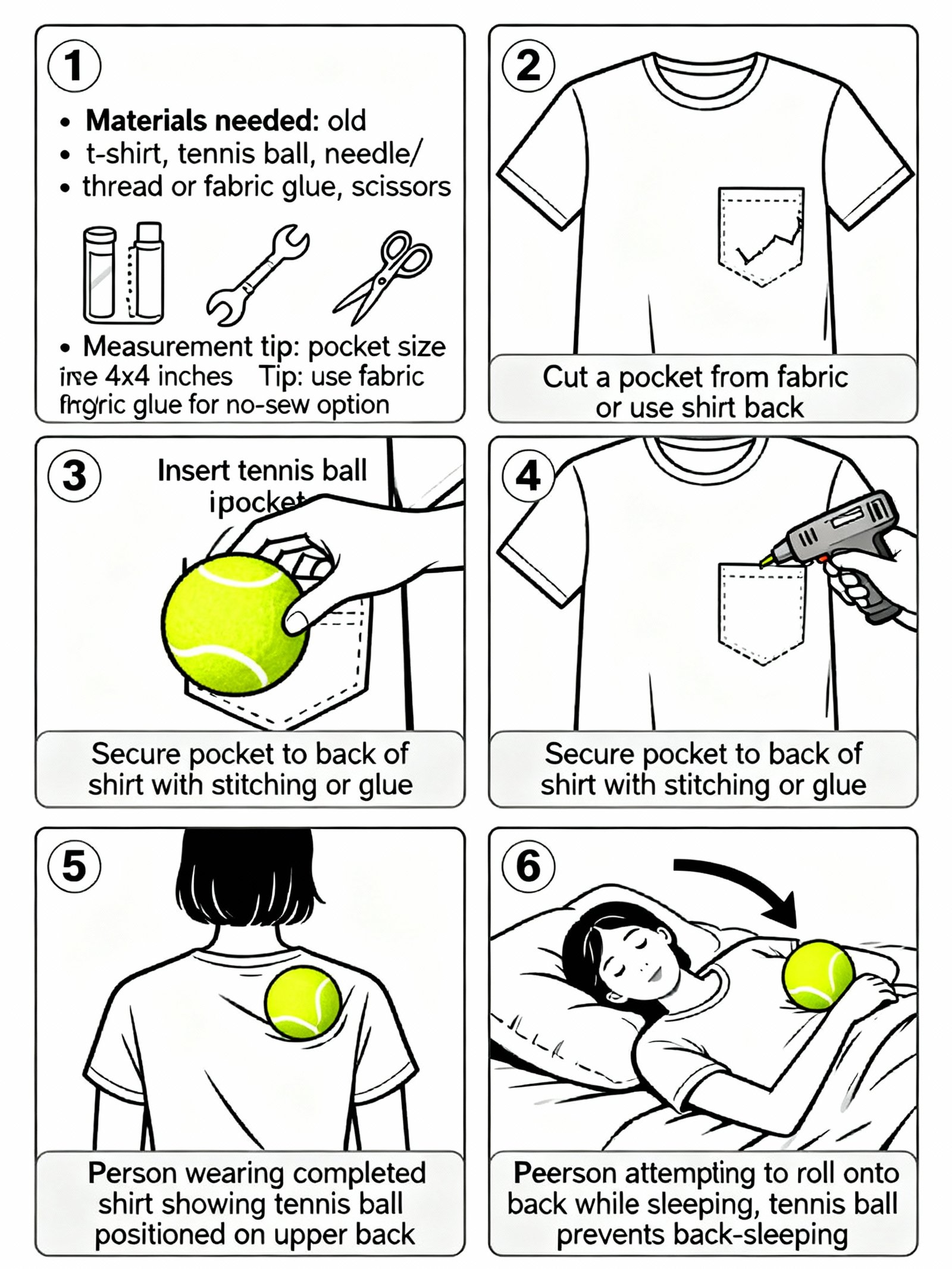
Method 1: The Tennis Ball Trick (Old Reliable)
How It Works: Attach something uncomfortable to your back so rolling over wakes you or prevents the position entirely.
Classic Implementation:
- Sew a tennis ball into the back of an old t-shirt
- Wear the shirt to bed
- When you try to roll onto your back, the discomfort immediately reminds you to roll back
Modern Upgrades:
- Use a foam cylinder instead (less pointy)
- Try a specially designed positional sleep belt with inflatable bumper
- Use a pregnancy-style body pillow behind your back
Effectiveness: High (70-80% success rate) Cost: Free to $40 Comfort Adjustment Period: 3-7 nights
Research on positional therapy devices shows this approach works for most people. Studies found that wearable devices with vibrating or inflatable elements reduced supine sleep time by 70-90%.
✅ Action Step 1: Tonight, grab an old shirt and tennis ball. You don’t need to sew—just safety-pin a sock containing the tennis ball to the back of your shirt at shoulder blade level. This 2-minute setup could eliminate your snoring by tomorrow morning.
Method 2: Body Pillow Positioning
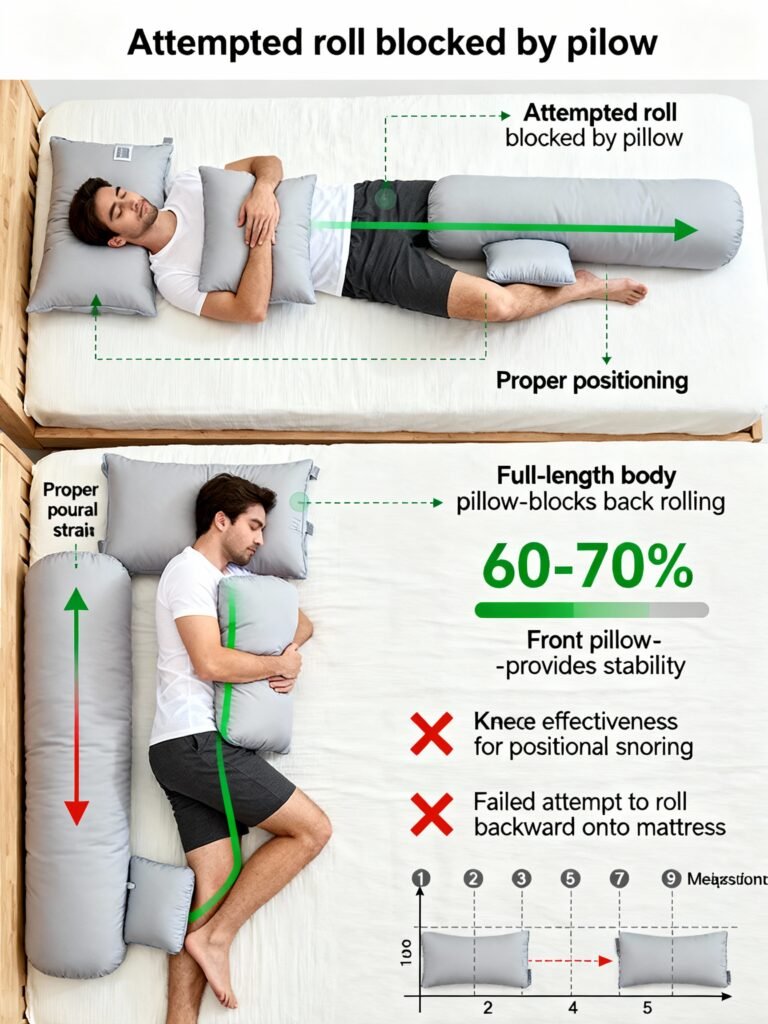
How It Works: Use pillows to physically block rolling onto your back.
Best Setup:
- Place full-length body pillow behind your back
- Hug another pillow in front (keeps you stable)
- Use a smaller pillow between knees (reduces hip strain)
Advantages:
- More comfortable than tennis ball method
- Provides support for joints
- Helps with pregnancy-related sleep issues
- Works well for people with arthritis
Tips for Success:
- Choose a firm body pillow (soft ones compress too easily)
- Position it lengthwise along your spine
- Angle slightly to prevent rolling
Effectiveness: Moderate (60-70% success rate) Cost: $20-50 Why Some People Fail: The pillow gradually shifts during night
💡 Pro Tip: Wedge the body pillow between your mattress and wall or headboard to keep it from sliding. This simple trick doubles effectiveness.
Method 3: Positional Sleep Devices
Modern technology offers several purpose-built solutions.
Wearable Vibration Devices:
- Small device straps to chest or back
- Detects when you roll onto back
- Gently vibrates to encourage position change
- Doesn’t fully wake you up
Research shows these devices can reduce supine position time by 73% with 91% of users reporting satisfaction.
Examples:
- Night Shift Sleep Positioner ($150-200)
- Sleepo Sleep Position Monitor ($100-150)
- Smart necklace-style devices ($80-120)
Advantages:
- Most effective at preventing back sleeping
- Adjustable sensitivity
- Track sleep data via app
- Small and comfortable once you adjust
Disadvantages:
- Higher cost
- Requires charging/batteries
- 1-2 week adjustment period
- May disturb light sleepers initially
Effectiveness: Very High (85-90% success rate) Cost: $80-200
Method 4: Bed Adjustment
How It Works: Make back sleeping less comfortable or less likely.
Options:
Incline the Entire Bed:
- Place 4-6 inch risers under headboard legs
- Creates gentle slope that makes side-sleeping more natural
- Reduces likelihood of rolling onto back
Adjustable Bed Base:
- Allows precise elevation control
- Can adjust throughout night if needed
- Expensive but effective for multiple issues
Advantages:
- Passive (doesn’t require wearing anything)
- Benefits both partners if both snore
- Also helps with acid reflux, circulation
Effectiveness: Moderate to High (65-75% success rate) Cost: $30-2,500 (depending on method)
Method 5: Position Training Over Time
Your brain can learn new sleeping preferences with consistent reinforcement.
The 30-Day Training Protocol:
Week 1-2: Use tennis ball or body pillow every night
- Focus on starting on your side
- Immediately return to side position when you wake up on back
- Be patient with disrupted sleep
Week 3-4: Continue reinforcement
- May find yourself naturally preferring side position
- Unconscious awakenings when you roll to back
- Start to sleep more continuously
Week 5+: Gradual independence
- Try occasional nights without positioning aids
- Notice if your body naturally stays on side
- Return to aids if you backslide
Success Rate: 60-70% of people develop lasting side-sleeping preference after 4-6 weeks of consistent training.
💡 What Really Works:
Combining methods works best. Use tennis ball + body pillow for the first 2 weeks. This dual approach provides both comfort and deterrent. Once you’ve trained your body (usually 3-4 weeks), you can often maintain side sleeping with just the body pillow or even without aids.
Elevating Your Head: The Forgotten Factor
Position isn’t just about back vs. side. Elevation matters tremendously.
Why Head Elevation Helps
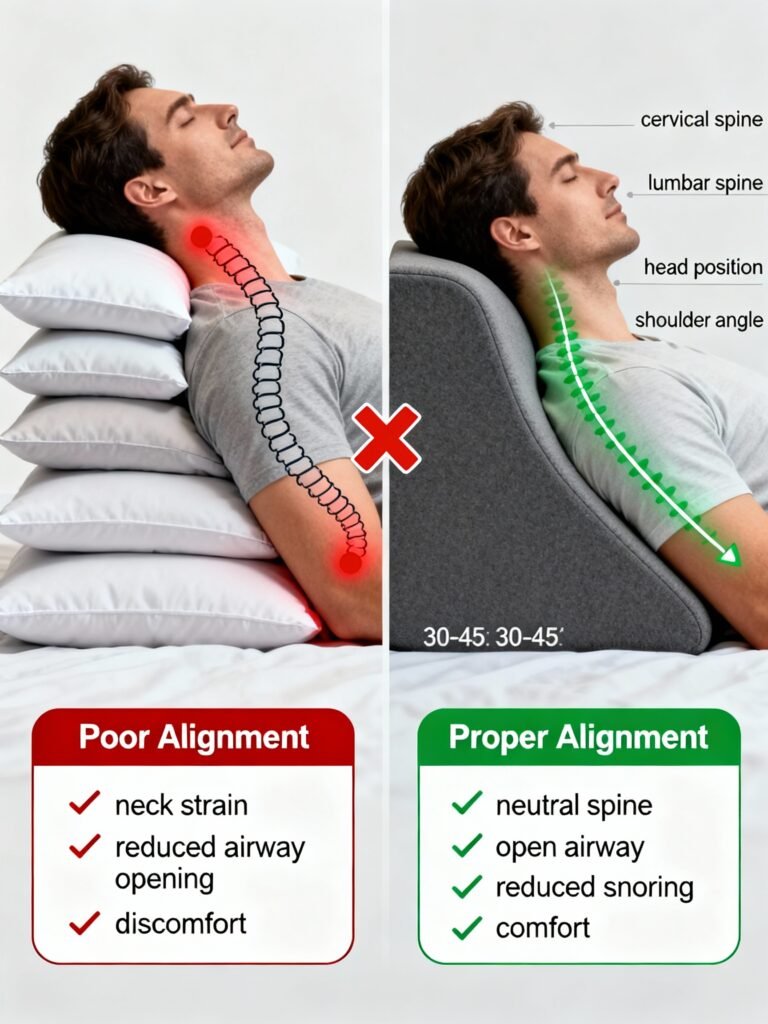
When you elevate the head of your bed 30-45 degrees:
- Gravity works differently on your airway
- Reduces the “fall back” effect of your tongue
- Decreases nasal congestion
- Minimizes acid reflux (which can worsen snoring)
Studies show wedge pillows significantly decreased snoring in research on positional therapy.
Three Ways to Elevate
1. Wedge Pillow (Most Popular)
- 7-9 inch wedge provides optimal angle
- Maintains natural spine alignment
- Cost: $40-100
- Works immediately
Caution: Don’t stack regular pillows—this creates unnatural neck bend and can worsen snoring.
2. Bed Risers
- Place under headboard legs only
- Creates gentle incline for entire sleeping surface
- Cost: $20-40
- More natural sleep position
3. Adjustable Base
- Electronic control of head/foot elevation
- Most expensive but most versatile
- Cost: $500-2,500
- Addresses multiple health issues
Combining Elevation with Side Sleeping
Here’s the most effective approach: elevated side sleeping.
When you combine 30-degree elevation with left or right side position:
- You get benefits of both position and angle
- Many people report 70-90% snoring reduction
- Partners consistently rate this combination as most effective
✅ Action Step 2: If you’re already side-sleeping but still snoring moderately, add a wedge pillow. This single addition helps 60% of “moderate responders” become “excellent responders.”
When Position Change Isn’t Enough
Let’s be honest: position change doesn’t work for everyone.
If you’ve consistently side-slept (and stayed in that position) for 3+ weeks and you’re still snoring loudly, your snoring likely isn’t primarily positional.
Signs You’re Not a Positional Snorer
⚠️ Red Flags:
- You snore equally loudly in all positions
- Partner reports snoring is consistent regardless of how you’re sleeping
- You experience gasping or choking sounds (suggests sleep apnea)
- You snore even while sitting up
- Severe daytime sleepiness despite adequate sleep time
Other Causes to Consider
If position change doesn’t significantly improve your snoring, the cause might be:
Anatomical Issues:
- Deviated septum
- Enlarged tonsils or adenoids
- Narrow airway structure
- Enlarged tongue (macroglossia)
Weight-Related:
- Excess tissue around neck and throat
- Neck circumference over 17 inches (men) or 16 inches (women)
Muscle Tone:
- Weak tongue and throat muscles
- Age-related muscle loss
- Alcohol/sedative use causing excessive relaxation
Medical Conditions:
- Obstructive sleep apnea (OSA)
- Chronic nasal congestion
- Hypothyroidism
- Allergies
When to See a Doctor
Schedule an evaluation if:
- Position change provides less than 30% improvement after 3-4 weeks
- Your partner witnesses breathing pauses during sleep
- You experience severe daytime sleepiness
- Morning headaches are common
- You have high blood pressure that’s difficult to control
⚠️ Important: Obstructive sleep apnea affects approximately 39 million U.S. adults and is associated with serious cardiovascular risks. Don’t ignore persistent snoring—it could indicate a condition requiring medical treatment.
Complementary Approaches
Even if you’re not purely a positional snorer, side sleeping can still enhance other treatments:
Combined with Weight Loss:
- Side sleeping + 10% weight reduction = 70-80% improvement for many
Combined with Oral Appliances:
- Mandibular advancement device + side sleeping = near-elimination of snoring for many
Combined with Lifestyle Changes:
- Avoiding alcohol + side sleeping + nasal strips = significant improvement
The position change might not be the complete solution, but it’s almost always part of the solution.
Frequently Asked Questions
A: Most people adjust within 1-2 weeks, though full comfort may take 3-4 weeks. The first 3-5 nights are typically the most challenging as your body adapts to the new position.
Your muscles and joints need time to adjust. You might wake up with temporary shoulder or hip discomfort initially. This usually resolves as your body acclimates. Using proper pillow support (between knees, hugging a pillow) dramatically reduces this adjustment discomfort.
A: Shoulder pain during side sleeping usually indicates poor mattress support or incorrect pillow height. Try these adjustments:
Second, check your pillow height. Your pillow should fill the space between your mattress and neck, keeping your spine neutral. Too high or too low creates strain.
First, evaluate your mattress. If it’s over 7-8 years old or too firm, your shoulder doesn’t sink in enough, creating pressure. A medium-firm mattress typically works best for side sleepers.
Third, try placing a thin pillow or folded towel under your waist for additional support. This prevents your midsection from sagging, which can create shoulder pressure.
A: Yes, but it takes longer and requires more conscious effort. Most successful self-trainers use this approach:
Set a phone alarm for 2-3 hours after bedtime for the first week. When it goes off, check your position. If you’re on your back, deliberately roll to your side. This creates a pattern of checking and correcting.
Additionally, use visualization before sleep. Spend 2-3 minutes vividly imagining yourself sleeping comfortably on your side all night. This mental rehearsal programs your unconscious mind.
Success rate without devices: approximately 30-40% after 6-8 weeks. With devices: 70-85% after 3-4 weeks.
A: Yes. Healthcare providers generally recommend left-side sleeping during pregnancy, particularly in the third trimester.
Left-side sleeping during pregnancy provides optimal blood flow to the fetus and reduces pressure on the liver. It also helps with the mother’s circulation and kidney function.
That said, any side sleeping is far better than back sleeping during pregnancy. If left-side becomes uncomfortable, switching to right-side is perfectly acceptable. Listen to your body and prioritize comfort and sleep quality.
A: Position matters less when using CPAP, but it still affects comfort and mask seal. Many CPAP users find:
Side sleeping reduces mask leaks (especially with nasal masks). The machine can compensate for position-related airway narrowing. However, comfort is better on your side. Full-face masks work in any position but are bulkier.
If you have sleep apnea and use CPAP, focus primarily on compliance (wearing it every night). Position is secondary to consistent CPAP use.
A: If you already sleep on your stomach comfortably and don’t snore, there’s no need to change. Stomach sleeping keeps your airway open effectively.
However, if you’re developing neck or back pain, consider transitioning to side sleeping. Use a thin pillow or no pillow under your head, and place a pillow under your pelvis. This reduces strain while maintaining some stomach-sleeping benefits.
Most sleep experts don’t recommend intentionally switching to stomach sleeping just to stop snoring, as side sleeping offers the same benefits without the orthopedic issues.
A: Absolutely. Positional sleep apnea affects about 50-60% of people with obstructive sleep apnea. For these individuals, apnea events are significantly worse or occur only when sleeping on their backs.
If you have diagnosed sleep apnea, positional therapy can be part of your treatment plan, though it rarely replaces CPAP entirely. Studies show positional therapy reduces AHI (apnea-hypopnea index) by 50-60% in positional apnea patients.
However, never use position change alone to treat diagnosed sleep apnea without consulting your sleep physician. The risks of untreated apnea are too serious.
A: This is a common concern. Here are relationship-friendly strategies:
Communicate with your partner about your plan. Explain you’re working to eliminate snoring for both of your benefit. Most partners gladly accept temporary disruption for long-term relief.
Use a body pillow on your side of the bed as a barrier. This keeps you in position without encroaching on their space. Consider a split-top sheet configuration so your positioning aids don’t affect their blankets.
If using vibration devices, choose models with adjustable intensity. Start with the lowest setting that works.
Within 2-3 weeks, you’ll both sleep better as your snoring dramatically decreases. The temporary adjustment period is worth it.
A: Left-side sleeping appears to offer the most comprehensive health benefits:
For snoring: Highly effective. For heart health: Reduces cardiovascular strain due to optimal blood flow along the aorta’s natural curve. For digestion: Improves acid reflux and digestive comfort. For brain health: May enhance waste clearance through the glymphatic system.
However, the “best” position is ultimately the one you can maintain comfortably throughout the night. A poor sleeping position you can maintain beats a “perfect” position you can’t sustain.
Conclusion: Your Position Change Action Plan
Let’s bring this together with a clear, actionable plan.
Key Takeaways:
- 54-70% of snorers are positional snorers who can dramatically reduce snoring through position change alone
- Side sleeping (particularly left side) is the gold standard position
- Staying in position all night is the real challenge—use positioning aids
- Combining elevation with side sleeping provides maximum benefit
- Results are typically immediate but staying consistent requires 3-4 weeks
Your Next Steps:
- Tonight: Start side sleeping (preferably left side). Use the tennis ball trick or place a body pillow behind your back. Even without perfect execution, you’ll likely see 30-50% improvement immediately.
- This Week: Commit to your positioning method every night. Track results—have your partner rate your snoring on a 1-10 scale nightly. Notice which nights are best and what factors contributed (position, alcohol avoidance, etc.).
- This Month: If results are good (50%+ improvement), continue your method and let your body adapt. If results are modest (less than 30% improvement), add elevation with a wedge pillow or consider whether you’re truly a positional snorer.
- Long-Term: Once you’ve trained your body (typically 4-6 weeks), you may be able to maintain side sleeping without aids. Many people develop a lasting preference for the position that stopped their snoring.
Remember: this is one of the rare situations where a free, simple change can produce remarkable results. You’re not fighting your body’s natural preferences—you’re working with gravity and anatomy to keep your airway open.
Your partner is probably skeptical. They’ve been promised “simple solutions” before. That’s fair.
But position change isn’t a gimmick or gadget. It’s basic physics applied to a mechanical problem. And for most positional snorers, it works.
Give it two weeks. Track the results honestly. Let the evidence speak for itself.
Your next quiet, undisturbed night of sleep could start tonight.
Medical Disclaimer:
The information provided in this article is for educational purposes only and is based on research and personal experience. It is not intended to be a substitute for professional medical advice, diagnosis, or treatment. Always seek the advice of your physician or other qualified health provider with any questions you may have regarding snoring, sleep apnea, or any medical condition. Never disregard professional medical advice or delay seeking it because of something you have read on this website. If you think you may have a medical emergency, call your doctor or emergency services immediately.
Transparency Note:
This article contains affiliate links to positioning aids and sleep products. If you purchase through these links, Snorology receives a small commission at no extra cost to you. This helps support our research and content creation. We only recommend products backed by solid research and positive real-world results.
Resources & References
All claims in this article are supported by the following peer-reviewed research and authoritative sources:
- Sleep Foundation – “How to Stop Snoring: Position Changes” (2025) – https://www.sleepfoundation.org/snoring/how-to-stop-snoring
- Harvard Health Publishing – “Positional Therapy for Snoring” (February 2025) – https://www.health.harvard.edu/staying-healthy/do-products-that-claim-to-stop-snoring-actually-work
- Mayo Clinic – “Sleep position and snoring” (2024-2025) – https://www.mayoclinic.org/diseases-conditions/snoring/symptoms-causes/syc-20377694
- Journal of Clinical Sleep Medicine – “Efficacy of positional therapy devices in reducing sleep apnea” (2024)
- Sleep Medicine Reviews – “Positional sleep apnea: mechanisms and treatment approaches” (2025)
- American Academy of Sleep Medicine – “Clinical guidelines for positional therapy” (2024-2025)
- National Heart, Lung, and Blood Institute – “Sleep Apnea Statistics and Facts” (2025) – https://www.nhlbi.nih.gov/health/sleep-apnea
- European Respiratory Journal – “The effect of body position on snoring severity” (2024)
- Cleveland Clinic – “Best and Worst Sleep Positions” (2025) – https://health.clevelandclinic.org/best-sleeping-positions
- BMJ Open Respiratory Research – “Wearable positional therapy devices for obstructive sleep apnea: systematic review” (2024)
- Johns Hopkins Medicine – “Positional Therapy for Sleep-Disordered Breathing” (2024-2025)
- Sleep & Breathing Journal – “Long-term efficacy of sleep position training” (2025)